
Introduction: The $9.6 Trillion Question
Every day, the global foreign exchange (forex) market sees a staggering $9.6 trillion change hands. This immense liquidity creates a powerful allure, suggesting endless opportunity. However, this opportunity is shadowed by a harsh reality: an estimated 70-80% of retail traders consistently lose money. The question is, why?
The answer isn’t a secret indicator or a hidden trading strategy. The difference between success and failure in this vast market is built on mastering three foundational pillars: Risk Management, Psychology, and a Professional Mindset. This guide will break down these pillars using data-backed insights, showing you how to focus on what truly matters for survival and long-term success.
——————————————————————————–
1. The Harsh Reality: Why Most Traders Fail
Before we talk about winning, we need to have a frank conversation about failure. Most traders skip this step, and that’s why they end up in the 80% who lose. You won’t. This isn’t meant to discourage you, but to ground you in the reality of the challenge and highlight why the principles that follow are so critical.
1.1. The Numbers Don’t Lie
Consider the following statistics that define the experience for most new traders:
- 70-80%: The percentage of retail traders who lose money over the long run.
- 1-3%: The tiny fraction of traders who achieve consistent, long-term success and earn a full-time living.
- 53%: The percentage of new traders who quit within their first year, often after significant losses.
- 5.5%: The share of the market’s total volume controlled by retail traders. To put that in perspective, institutional players—banks, hedge funds, and corporations—control the other 94.5%. You are not just a small fish; you are plankton in an ocean of whales. This is why you cannot trade like them and must prioritize survival above all else.
The game isn’t about getting rich overnight—it’s about surviving the first 6-12 months while you learn. Simply by surviving, you place yourself in the top percentile of all retail traders.
This focus on survival is critical because experience is a major factor in success. While most beginners fail, the source reveals that 85% of traders with 4+ years of experience report profitability. Your goal is to survive long enough to become one of them.
1.2. The Four Horsemen of Account Failure
Analysis of trader performance consistently points to four primary reasons why accounts are wiped out. Recognizing them is the first step to avoiding them.
- Excessive Leverage: This is using borrowed money to place a large bet, which makes it the fastest way to wipe out your account. A small market move against you can result in a 100% loss.
- Poor Risk Management: This means trading without a safety net. It’s the financial equivalent of driving a race car with no brakes or seatbelt.
- Psychological Biases: Allowing emotions like fear, greed, and overconfidence to dictate your decisions is a guaranteed path to irrational and costly mistakes.
- Inadequate Education: Jumping into live markets without a deep understanding of market mechanics and a tested strategy is like trying to navigate the open ocean without a map or compass.
Understanding these pitfalls is crucial. The three pillars that follow are the direct antidote to these common and catastrophic failures.
——————————————————————————–
2. The Three Pillars of Forex Survival
Success in trading is a three-legged stool. If any one of these pillars is weak, the entire structure will collapse, regardless of how brilliant your trading strategy is.
Pillar 1: Iron-Clad Risk Management (Your Shield)
Let me be blunt: Your first job as a trader is not to make money; it is to be an expert risk manager. Profits are the byproduct of excellent capital protection, not the other way around. It is your shield against the market’s inherent volatility.
Memorize these rules. Write them down. Tape them to your monitor. They are not suggestions; they are the laws of survival.
| The Rule |
Practical Application |
Why It’s Non-Negotiable |
| The 1-2% Rule |
Never risk more than 1-2% of your total account balance on a single trade. |
It mathematically ensures you can withstand a long string of losses without blowing up your account, giving you time to learn and adapt. |
| Mandatory Stop-Loss | Every trade you enter must have a pre-defined stop-loss order that automatically closes your position at a specific loss level. | This removes emotion from the decision to cut a loss. It is your ultimate safety net, preventing a single bad trade from causing catastrophic damage. |
| Positive Risk-Reward Ratio | Only take trades where your potential profit is at least twice your potential loss (a minimum 1:2 risk-reward ratio). | This is the core of professional trading math. As the data shows, a 50% win rate with a 1:3 risk-reward ratio yields substantial profits. You don’t have to be right most of the time to be highly profitable. |
| Sane Leverage | Use low leverage, ideally between 1:10 and 1:30. | High leverage is the number one cause of retail account blowouts. Low leverage reduces psychological pressure and increases your probability of survival dramatically. |
Proper risk management is what separates professional trading from gambling. It is the framework that allows a profitable strategy to work over the long term.
Pillar 2: Unshakable Psychology (Your Mindset)
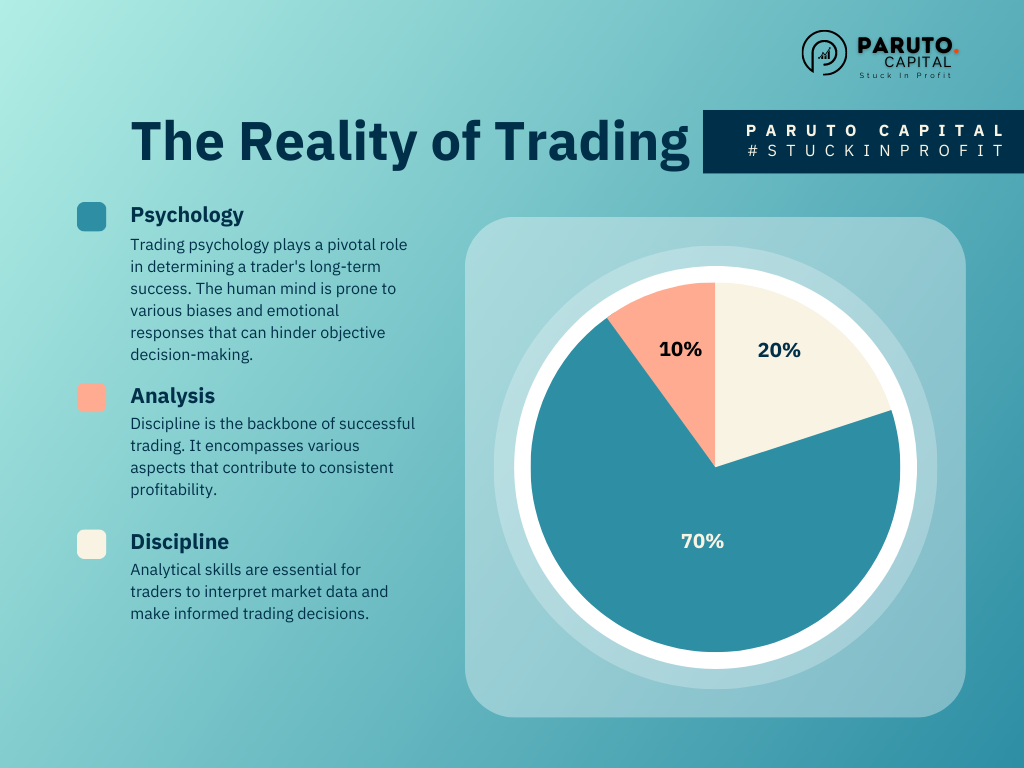
According to a breakdown widely cited by behavioral finance coaches, your psychological state is the most significant factor in your trading success. The estimated allocation is startling:
- 60% Psychology
- 30% Money Management
- 10% Strategy
Your mind is the biggest battlefield. Here are the most common mental traps and the antidotes to protect you.
|
The Bias |
The Behavior |
The Antidote for New Traders |
| Loss Aversion |
Holding losing trades for too long, hoping they will turn around. |
Accept small losses as a standard business expense, not a personal failure. Use a mandatory stop-loss on every trade and never, ever move it further away from your entry price. |
| Overconfidence | Taking excessive risks after a few wins, believing you have a “magic touch.” |
Maintain a detailed trading journal. This grounds your decisions in objective data, not fleeting feelings of invincibility. |
| Confirmation Bias | Seeking only information that supports your trade idea while ignoring contradictory evidence. | Before every trade, actively seek out and write down the strongest argument against your position. |
| Revenge Trading | Jumping back into the market after a loss to impulsively “win back” your money. | Enforce a mandatory “cooling-off” period after any significant loss. Step away from the screen for at least an hour. |
Pillar 3: A Professional Mindset (Your Business Plan)
The final pillar is treating trading as a serious business, not a hobby, a game, or a lottery ticket. This requires a professional approach built on patience, planning, and realism.
Hallmarks of a Professional Approach
- Education First: An alarming 72% of new traders have no prior experience. A professional commits to a minimum of 2-3 months of dedicated education before risking a single dollar.
- Realistic Time Horizon: Understand that this is not a get-rich-quick scheme. Achieving consistency can take 12-24 months, and earning a full-time income typically requires 4+ years of dedicated effort.
- Realistic Profit Goals: Ignore claims of 50%+ monthly returns; they indicate unsustainable risk. Professionals aim for a consistent 1-5% return per month.
- Adequate Capital: The source is clear on this: accounts under $1,000 have an “extremely high failure rate,” while accounts over $10,000 have “substantially better survival rates” because they allow a trader to apply the 1-2% rule without being restricted to meaningless profits.
Mastering these three pillars creates the foundation upon which a trading strategy can actually function and produce results.
——————————————————————————–
3. Strategy: Your Toolkit, Not Your Savior
A trading strategy is simply a set of rules for identifying when to buy or sell. It’s a critical tool, but it is only effective when wielded by a trader with discipline and solid risk management. Traders primarily use two types of analysis to build their strategies:
- Fundamental Analysis: Evaluating broad economic forces, interest rates, and geopolitical events to determine a currency’s long-term, intrinsic value.
- Technical Analysis: Using charts, patterns, and statistical indicators to identify repeatable price behaviors and optimal entry and exit points.
The most successful traders often use a hybrid approach: they use fundamental analysis to decide which currency to trade (the long-term direction) and technical analysis to decide when to trade (the precise timing). For new and part-time traders, research shows that swing trading (holding positions for days to weeks) on 4-hour to daily timeframes offers the most optimal risk-adjusted returns.
Ultimately, you must remember the widely accepted 60/30/10 rule. A mediocre strategy combined with excellent risk management and psychological discipline will always be more profitable than a brilliant strategy with poor discipline.
——————————————————————————–
4. A Practical Path for the Aspiring Trader
Now that you understand the principles, let’s build your career path. Do not deviate from this sequence. Rushing is a guaranteed recipe for failure. Follow this data-driven, sequential path to build competence methodically.
The Four-Stage Journey to Competence
- Stage 1: The Education Phase (2-3 Months Minimum) Your only job is to learn. Study market mechanics, risk management principles, and trading psychology. Absorb everything you can about different strategies without risking any money.
- Stage 2: The Simulator Phase (3-6 Months) Open a demo account and practice your chosen strategy in a live market environment. The goal is not to make a mountain of fake money, but to execute your plan with perfect discipline and develop consistency.
- Stage 3: The Small Live Account Phase (6-12 Months) Begin trading with a small amount of real money you can fully afford to lose. Your focus must remain on flawless execution of your plan using the smallest possible position sizes. The goal is to master your process, not to make a profit.
- Stage 4: The Scaling Phase (24+ Months) Only after you have achieved consistent profitability (even if small) for several consecutive months should you consider gradually increasing your position size. This phase is about patiently scaling a proven, profitable process.
——————————————————————————–
Conclusion: Survive First, Then Thrive
The grim statistics are not your destiny; they are a warning sign for the unprepared. The path to the top 1-3% isn’t a secret. It’s a formula: Protect your capital like a fortress with iron-clad risk management. Master your mind to defeat fear and greed. And treat this endeavor with the seriousness of a business owner, not a gambler.
In this arena, survival is the first and greatest victory. Master that, and you will earn the right to thrive.